
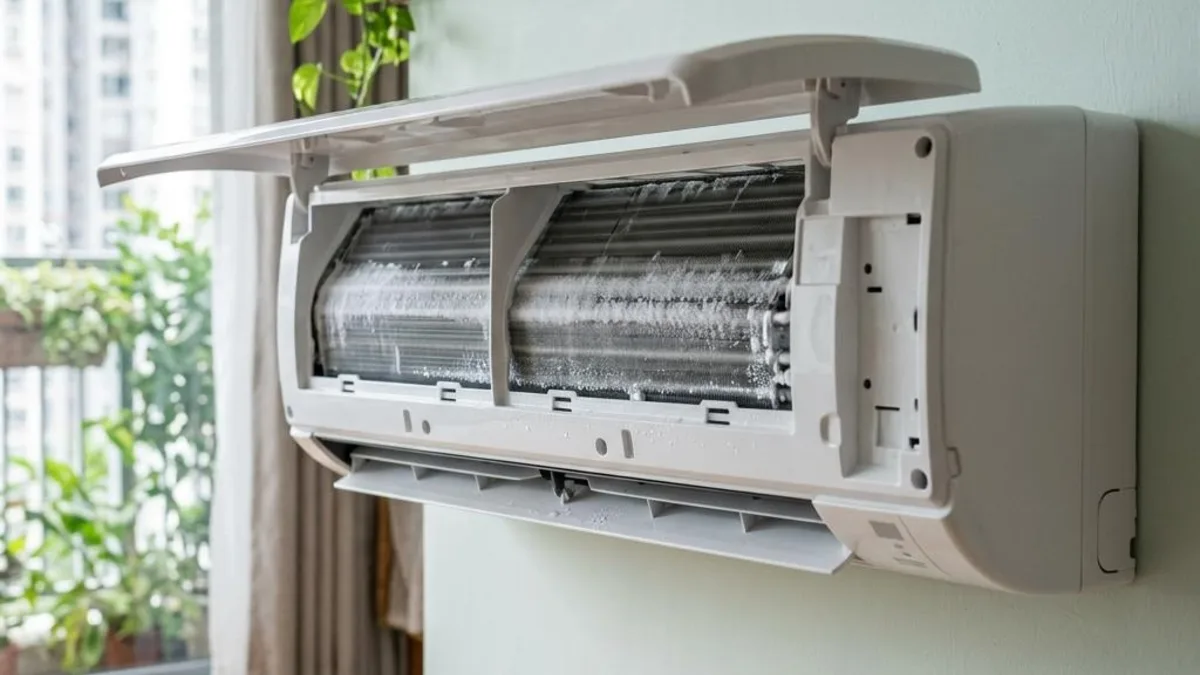
Is frosting caused by being too dirty? Can cleaning solve icing problems?
Contents
During periods of heavy summer use, many users suddenly find that the airflow from the outlet has become weak, or that the unit starts leaking water or making strange noises. When they open the casing, they discover that the evaporator inside has already formed a thick layer of frost or ice. Many people's first reaction is that the air conditioner has not been cleaned for too long and is full of dirt, so they immediately hope that cleaning the air conditioner will solve the problem completely. In fact, the causes of icing are quite complex. Dirt buildup is indeed one of the common main causes, but whether cleaning the air conditioner can solve the icing problem once and for all depends on the real source of the frost on the unit.
Restricted air circulation causes the evaporator to become too cold and freeze
The cooling process of an air conditioner relies on indoor air continuously passing through the evaporator (aluminium fins) for heat exchange. When an air conditioner has not been maintained for a long time, and the filter and aluminium fins are blocked by thick dust, hair, and grease, or when the fan wheel slows down due to heavy dirt buildup, the intake and output airflow will decrease significantly. Without enough warm indoor air for heat exchange, the refrigerant inside the evaporator cannot absorb enough heat, and the temperature drops sharply below zero. At this point, moisture in the air adheres to the overcooled aluminium fins and quickly condenses into frost, creating increasingly severe icing.
AC cleaning can effectively solve frosting problems caused by dirt buildup
If the on-site inspection confirms that frost is related to dirt affecting airflow, cleaning the relevant parts may be part of the solution. After completion, airflow, operation, and whether freezing happens again still need to be checked; no claim is made that any water pressure or product is suitable, and cleaning is not guaranteed to instantly solve every cause of frosting.
Frosting caused by refrigerant leakage or system faults cannot be solved by cleaning alone
However, not all frosting problems can be solved by AC cleaning alone. When there is a micro-leak in the refrigerant inside the air conditioner due to pinholes in the copper pipe or a loose joint, the internal pressure of the system will drop abnormally, causing the refrigerant to evaporate too early at the initial stage of entering the evaporator and leading to localised icing from extremely low temperatures. In addition, if the temperature sensor fails, the compressor relay malfunctions, or the inverter model's circuit board calculation is abnormal, causing the compressor to keep operating at high load even when the fan is not running properly, icing can also occur. These mechanical or system-level faults cannot be fixed by cleaning the unit alone; a technician must inspect, leak-test, and replace parts.
Secondary damage to the unit caused by delayed frost treatment
When you notice signs of frosting on the air conditioner, do not ignore it or keep running it forcefully. Thick frost will further block the airflow path, keeping the compressor under high load for a long time and increasing the risk of failure. At the same time, when the unit is turned off and the frost melts, the meltwater may exceed the capacity of the drip tray, causing dripping indoors and even wetting the walls and furniture. Therefore, once frosting is found, you should immediately turn off cooling mode, switch to fan mode to let the ice melt naturally, and arrange a professional inspection as soon as possible to prevent a minor fault from becoming more serious damage.
Seek help from a professional team
Air conditioner frosting involves multiple complex factors, including airflow dynamics, heat exchange efficiency, and refrigerant pressure. Blindly disassembling and cleaning it yourself or applying chemicals at random often fails to address the real issue. When facing icing problems, the safest approach is to choose an experienced professional air-conditioning engineering team for a comprehensive inspection. Professional technicians will accurately test refrigerant pressure and the unit’s wiring before cleaning to confirm the real cause of the frosting. If the cause is dirt blockage, they will use professional equipment for deep, high-pressure descaling. If it is a mechanical fault, they can also provide an accurate repair solution immediately, helping restore the unit to its best performance and bringing a fresh, quiet cooling experience back to your home.
Related reading and services
Need professional help?
Need to know about AC repair service? First check the service scope and arrangements, then provide the model and site details for enquiry