

If the air conditioner has not been used for several months, what should be checked before turning it on again?
Contents
A long period of non-use does not mean the air conditioner is definitely clean, nor does it mean it is definitely broken. Before restarting, check the manufacturer's instructions for safety and maintenance conditions, especially if the room has been damp, renovated or water-damaged. There is no need to open the unit yourself just to test it.
First observe the appearance and surrounding environment.
From the ground, check whether there are obstructions, visible damage, drip marks or unusual odours near the air outlet and air inlet. If there has been water leakage, a tripped breaker or a burning smell that has not been addressed, do not assume it has recovered on its own after being left unused for a few months.
The location of the outdoor unit, mounting bracket, and equipment at height cannot be inspected closely by ordinary customers. A full view that can be taken safely may be provided, and suitable personnel will assess it. Do not climb onto the windowsill, remove the electrical box, or touch the fins by hand.
Handle filters and remote control according to the instructions
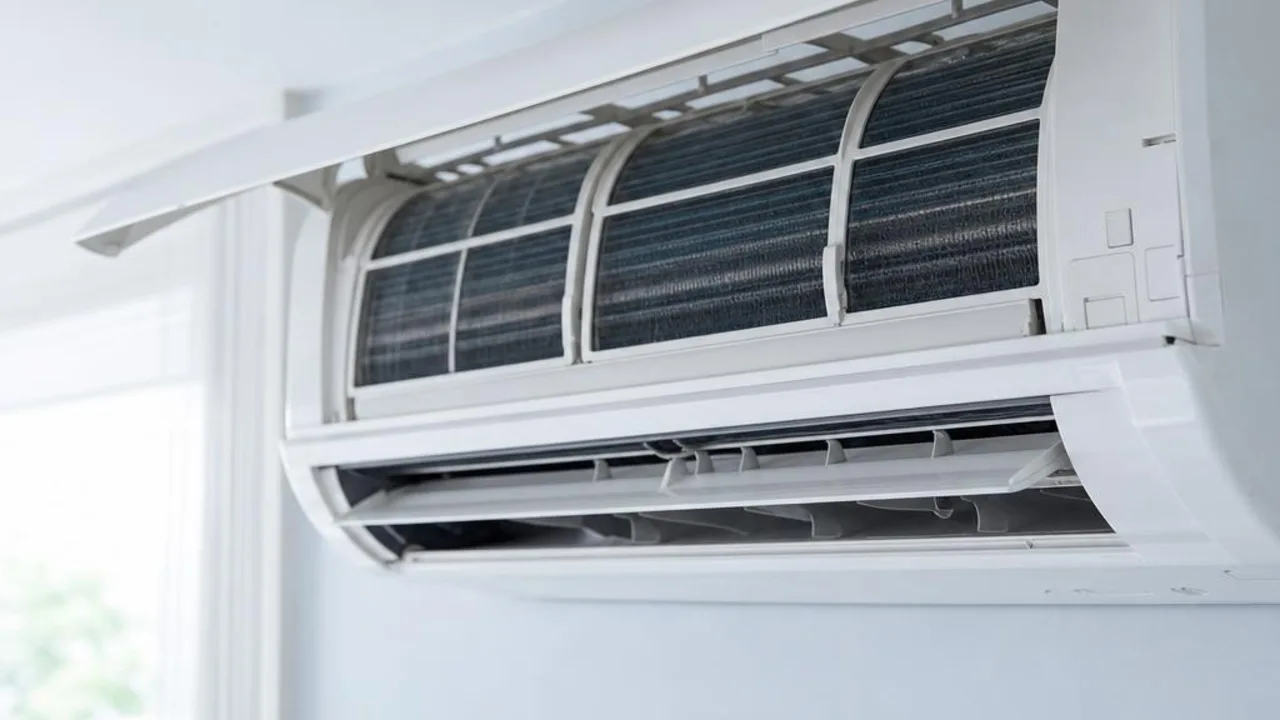
Only handle filters that the manufacturer allows the user to remove and wash, and first stop operation and safely turn off the power according to the instructions. Special filter materials may not be washable; reinstall only after they are completely dry. Do not test the unit before all specified parts are properly reinstalled.
If the remote has been left unused for a long time, check the batteries and display, and replace them with suitable batteries according to the instructions. Leaks or corrosion must be handled safely, and do not mix new and old batteries just for testing; a display on the remote does not mean the main unit has correctly received the setting.
Do not switch the unit on and off repeatedly in quick succession when restarting it.
Choose the appropriate mode according to the model manual, and pay attention to whether it runs normally, whether airflow is normal, and whether drainage is working. Some models have a protective delay; do not repeatedly cut power just to cool down faster. Also, do not use an extremely low setting as a full performance test.
If there are unusual scraping noises, a burning smell, a fault light, severe water leakage or a tripped breaker, stop using it first. Musty smell and dust build-up can be assessed for cleaning, but safety symptoms should be checked first; cleaning alone cannot be guaranteed to solve the problem.
For the next long period of non-use, you can prepare records in advance
Handle drying, maintenance, and shutdown according to the manufacturer’s recommended arrangement; some models have a designated mode. Do not apply a generic "fan-only for a few hours" approach or randomly switch off the main power if you are not familiar with it. Power and remote-control battery arrangements should follow the model instructions.
Record the condition before the unit was taken out of use and the date of the last cleaning, so it is easier to compare when it is used again. If you are unsure about the internal condition or there is obvious dust buildup, you may provide the model and photos for enquiry; there is no need to replace the unit just because it has been idle.
Related reading and services
- Safety steps for cleaning the dust filter
- Equipment inspection after moving into a new home
- When should deep cleaning be assessed?
Common questions
If it hasn’t been used for a few months, must it be deep-cleaned first?
Not necessarily. It depends on the original manufacturer's maintenance requirements, dust buildup, environment and current symptoms. Cleaning the dust filter and cleaning the inside of the unit are two different scopes; if there is an abnormal condition, it should be assessed first rather than being determined only by months of inactivity.
The unit makes a strange noise when first switched on. Can I try turning it on a few more times?
Do not keep restarting to test abnormal noises. First distinguish between normal operation described by the manufacturer and abnormalities such as friction or a burning smell; if there are dangerous symptoms, stop using it and seek inspection.
Reference sources and applicable scope
This article provides a preliminary guide only and does not replace an on-site diagnosis. Original manufacturer functions and operation apply only to the corresponding model; please refer to your own unit's manual. For fixed electrical installations, inspection should be arranged by a registered electrical contractor.

Need professional help?
Need to know about Residential air conditioning service? First check the service scope and arrangements, then provide the model and site details for enquiry