
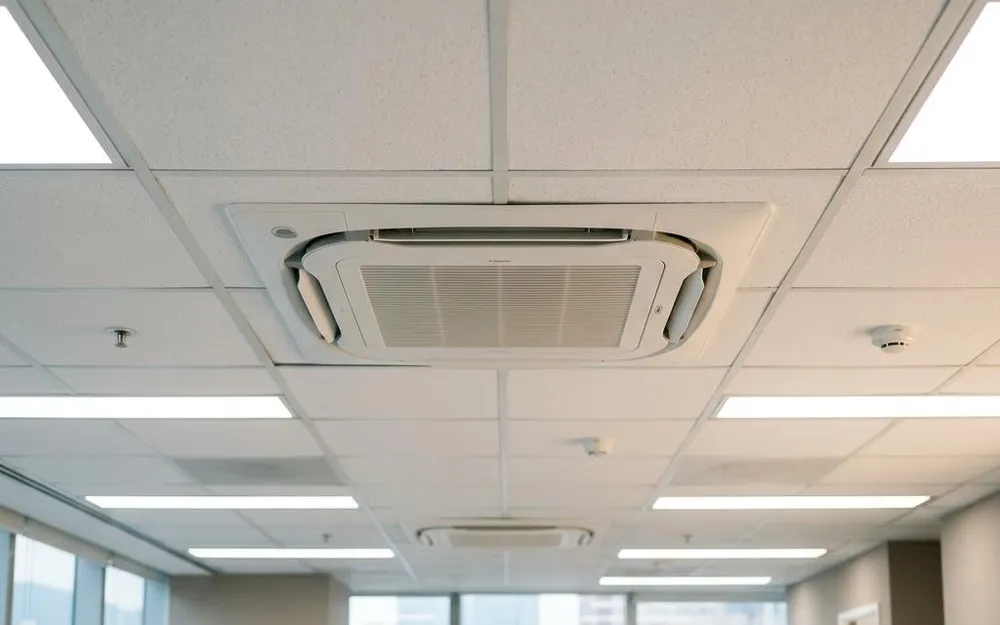
Split vs central AC | Choose the system that suits you best
Contents
There are many types of AC systems on the market, which can make choosing difficult. This article compares the features of split AC and central AC in detail to help you choose the system that best suits your needs.
Split vs central AC | Split AC
A split AC, also called a wall-mounted AC, is a unit installed on an indoor wall. It consists of two parts, an indoor unit and an outdoor unit, connected by refrigerant piping. The features of a split AC are as follows:
Split-type air conditioner
Advantages:
- Easy installation: Split-type air conditioners are relatively easy to install and are suitable for rented properties or buildings where central air conditioning cannot be installed. The indoor unit is mounted on the wall, while the outdoor unit is installed on the balcony or exterior wall. In addition, split-type air conditioners do not require extra duct installation, reducing complex work.
- Affordable price: Compared with central air conditioning, split-type AC has a lower initial investment, making it easier for consumers with limited budgets to afford. In addition, there are many brands and models of split-type AC available on the market, so the price range is relatively wide.
- Good energy-saving performance: split-type air conditioners are highly energy efficient. With inverter technology, operating speed can be adjusted automatically according to indoor temperature to achieve energy savings. Many split-type AC products have earned ENERGY STAR certification, confirming their energy-saving performance.
- Independent control: each indoor unit can be controlled separately, allowing you to adjust the temperature of each room to suit your needs. This is a major advantage for households with family members who prefer different levels of comfort.
Disadvantages:
- Limited application range: split-type air conditioners are mainly suitable for single rooms or smaller spaces such as flats, offices and shops. For large buildings, multiple split-type units may be required, increasing installation and maintenance complexity.
- Appearance impact: the indoor unit may affect interior decoration, while the outdoor unit may affect the building’s exterior. Although there are many stylish split-type AC designs on the market, their impact on the interior and exterior cannot be completely eliminated.
- Regular cleaning and maintenance are required: split-type air conditioners need their filters cleaned regularly to maintain good performance. Also, because each unit needs separate maintenance, maintenance costs may be higher.
Central air-conditioning unit
A central air-conditioning unit is a system that can provide heating and cooling air for an entire building. It distributes conditioned air to each room through ducts. The following are the features of central air-conditioning:
Advantages:
- Wide application range: central air conditioning is suitable for large buildings such as residential buildings, office towers and commercial premises. It can provide uniform heating and cooling air throughout the building, improving comfort.
- Neat appearance: compared with split-type air conditioners, central air conditioning looks cleaner because it distributes air through ducts hidden in the ceiling or walls, without affecting interior decoration or the building exterior.
- Integrated control: Central air conditioning can be centrally controlled through a smart thermostat, making it convenient to use. Some systems also support zone control, allowing the temperature to be adjusted according to the needs of different areas.
- Better air quality: central air conditioning is usually equipped with high-efficiency filters, which help improve indoor air quality. Some systems can also be combined with a fresh air system to further improve air quality.
Disadvantages:
- Higher upfront investment: central air conditioning has a relatively high installation cost and may not be suitable for buyers with a limited budget. In addition, because ductwork and other related facilities need to be installed, there are certain structural requirements for the building.
- Higher operating cost: although the energy efficiency of central air conditioning has improved over the past few years, its operating cost is still higher than that of split-type AC. In addition, central air conditioning usually requires professional maintenance, which also adds to the maintenance cost.
- The installation process is more complicated: central air conditioning installation is relatively complex and may require a professional installation team. In addition, the installation process may affect the building to a certain extent, such as requiring drilling or duct installation.
Overall, choosing between split-type AC and central air conditioning depends on your needs and budget. If you need heating and cooling for a single room or a smaller space, and want to save on initial investment, a split-type AC may be an ideal choice.
Related reading and services

Want to arrange AC cleaning or maintenance?
OPOExpert Air Conditioning provides residential and commercial AC cleaning and maintenance with clear pricing. Enquiry first or book online directly